Constraints can create the project
I did not choose the China course because of a master plan. I landed there after failing to choose another option on time. The accidental brief created the space for a much more consequential experiment.
Origin story · 1999–2000
A one-week school assignment became an interactive website, a national web award and the accidental first chapter of my founder story.
I built the first version in 1999 as a student at Reims Management School. It used interactive timelines, layered maps and rollover navigation to explain Chinese history and geography — before Wikipedia existed and before I had vocabulary for product design or data visualisation.
The accidental brief
Reims · 1999
At the end of a one-week introduction to China, students could return any kind of document showing what they had learned. A classmate and I chose a website.
I was a student in the Programme Grande École at Reims Management School. I was also busy, disorganised and late choosing an elective. The administration placed me into a one-week cultural introduction to China.
At the end of that week, the assignment was unusually open: bring back something that demonstrates what you learned, in whatever format you choose. A classmate and I decided to create a website. I did most of the technical and interface work because I already knew some programming and had started experimenting with Macromedia Flash.
The result was not a conventional school report moved onto a screen. I wanted to make the structure of the subject visible: thousands of years of history, dynasties, people and events on one side; rivers, neighbouring countries, relief, provinces and cities on the other.
Before I knew the vocabulary
IT WAS INFORMATION ARCHITECTURE, DATA VISUALISATION AND INTERACTION DESIGN — BUILT AS A STUDENT REPORT.
The domain became toutelachine.com. The project kept growing after the class ended. It turned into an independent guide to Chinese history, geography and culture rather than disappearing into a professor's folder.
History as an interface
Move the pointer across dynasties, people and events and the interface changed in place. Context remained visible instead of forcing users through a sequence of disconnected pages.
Interface idea · 1999
This is a simplified reconstruction, not a screenshot of the original Flash interface. The surviving site still contains the original visual language and timeline structure.
Visit the surviving siteGeography as layers
The map could show rivers, neighbouring countries and relief independently or in combination. Hovering the Venn diagram switched the geographic layers without leaving the map.
What interested me was not simply drawing a map. It was giving the user a compact control for asking different questions of the same geography.
Rivers alone explained one system. Relief alone explained another. Countries alone explained another. Combining them exposed relationships — without duplicating the map or asking the visitor to understand a conventional menu hierarchy.
ONE MAP. THREE LAYERS. SEVEN POSSIBLE COMBINATIONS.
Clics d'Or · 2000
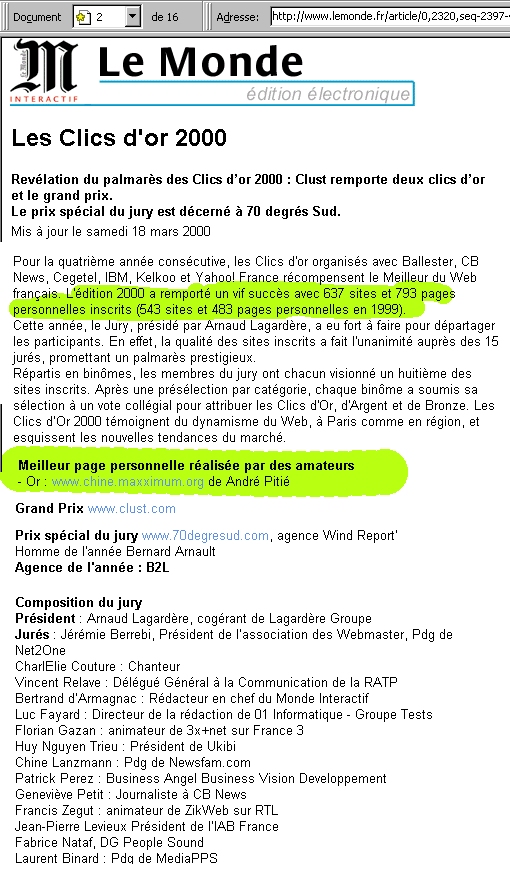
The Clics d'Or were created in 1997 under the CB News and Yahoo! banner and became one of the gathering points of the emerging French internet industry. The ceremony typically brought together around a thousand people from agencies, media, services and the wider web economy.
In 2000 the winner list included Clust, Boursorama, Transfert.net, 70 Degrés Sud — and Bernard Arnault as “Homme de l'année”. Toutelachine.com won the Grand Prix du public for an amateur/personal page.
That context matters. I was not arriving with an agency, a funded startup or a network in Paris. I was a student in Reims with a website that had begun as homework. Suddenly I was in the same room as people building the first generation of French internet businesses.
The unexpected media life
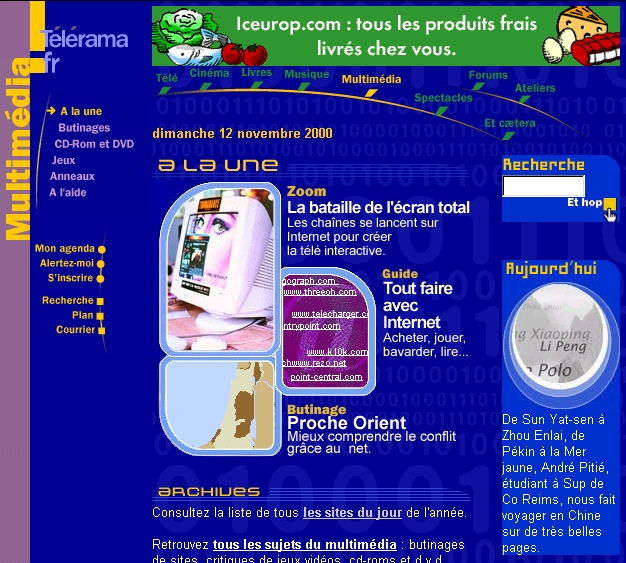
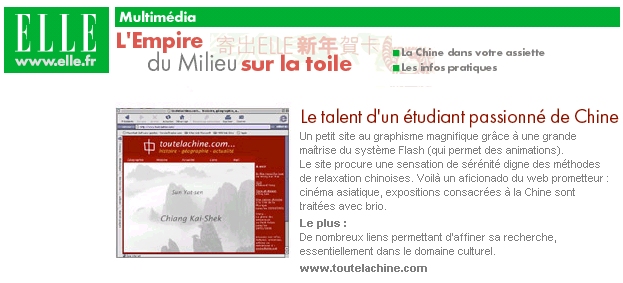
Toutelachine kept appearing in mainstream and specialist media: Le Monde, Télérama, Elle, France Culture, France 5, Encarta, Nouvel Obs and others.
The 2000 awards placed Toutelachine.com among the public-prize winners of a competition that had become a meeting point for the French web industry.
A national media recommendation only months after a school assignment became a public website.
Elle highlighted the project as the work of a student passionate about China and singled out its graphics and Flash animations.
The project kept being recommended as a useful way to explore Chinese history and geography long after the award.
The connection that mattered
At the Clics d'Or ceremony I met François Guilmoto, the entrepreneur behind Minitelorama, one of the businesses that had learned how to make money from information services in the Minitel era and was moving those activities onto the web.
We stayed in touch. We met again and explored whether there was a business to build around China. There wasn't an obvious one. A few months later I came back with something completely different: Trombi.com, a very young student directory showing early viral traction.
He understood the network effect immediately. Minitelorama helped finance the incorporation, gave the project office space and access to advertising inventory. I had very little financial safety net and very little negotiating power, so the terms were far more investor-friendly than I would ever recommend to a founder today. But the deal kept the project alive.
That is the thread I now find extraordinary: an unwanted course produced a website; the website produced an award; the award produced a relationship; the relationship gave a three-month-old social product its first institutional backing.
Continue to Trombi.comWhat survived
I did not choose the China course because of a master plan. I landed there after failing to choose another option on time. The accidental brief created the space for a much more consequential experiment.
The rollovers were not decoration. They let a user move through time and layers without losing context. The interface was part of the way the subject was taught.
The award and press did more than validate the website. They put me in rooms and relationships I would never have reached as a student sending CVs.
I did not know terms such as product design, information architecture or data visualisation. I simply wanted a better way to understand a complex system and learned the tools needed to make it.
Afterword
Toutelachine never became the company. That is why it matters in this portfolio. It reminds me that a project does not need a business model to have enormous career leverage.
It taught me that I liked turning dense information into something explorable. It gave me confidence that people outside my school could care about something I had built. And it introduced me to the person who would help get Trombi.com incorporated.
The founder story begins later. The builder story begins here.
Sources & digital archaeology